
Jacopo Scassellati
Artist. Sculptor.
Biography
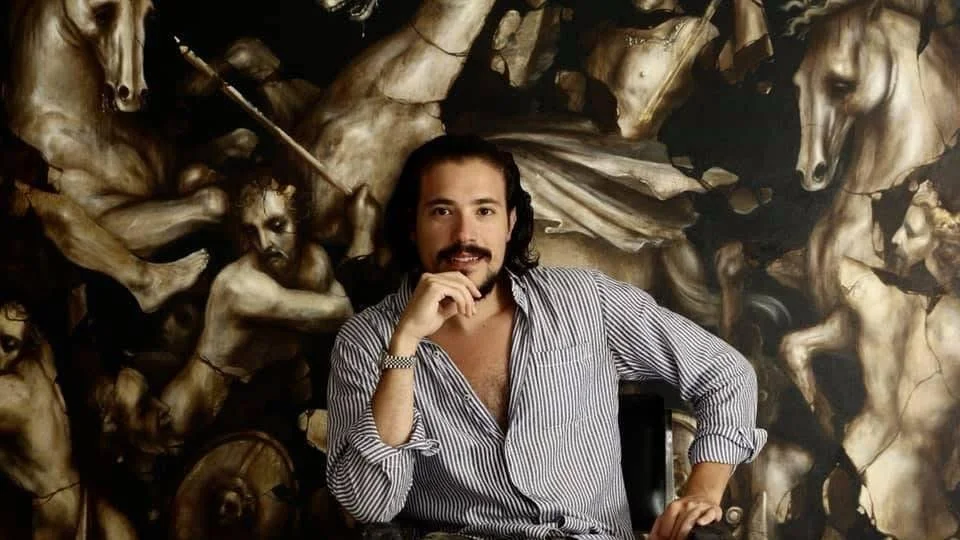
Jacopo Scassellati was born in 1989 in Sassari, Sardinia, where he lives and works today. Raised between Sardinia and Umbria in a family of artists, he grew up inside his grandfather's ceramic workshop, absorbing from an early age the discipline of clay, pigment, and form.
A painter and sculptor, Scassellati's work meditates on memory, light, and transcendence. Rooted in the human figure yet suspended in a realm of timeless symbols, his art moves between the sacred and the sensual, the ancient and the contemporary.
Working between painting and glazed terracotta sculpture, he revives ancient materials and archetypal imagery to explore the fragile balance between matter and spirit. His canvases — often rendered in restrained tones of black, white, and ochre — evoke the chiaroscuro tradition of Italian painting, filtered through a metaphysical sensibility. Figures emerge from darkness like fragments of collective memory: mythic, yet unmistakably human.
His sculptural practice, forged in the family's traditional ceramic atelier, translates this same dialogue into three-dimensional form. Through clay, fire, and glaze, he gives tangible presence to psychological and spiritual narratives drawn from classical mythology, sacred history, and cultural memory.
Scassellati's academic formation reflects the breadth and seriousness of his artistic ambitions. He earned his First-Level Academic Diploma in Decoration from the Accademia di Belle Arti "Mario Sironi" in Sassari in 2012, before completing a Specialization in Painting at the prestigious Accademia di Belle Arti "Pietro Vannucci" in Perugia in 2014. That same year, he pursued advanced studies at the Académie Royale des Beaux-Arts de Liège in Belgium — one of Europe's oldest fine arts academies — deepening his engagement with the European painting tradition. Alongside his academic training, he pursued an intensive study of sacred art, completing master-level programs at two of Italy's foremost centers for contemporary sacred art: the Museo Diocesano d'Arte Contemporanea at the Castello di Scopoli in Foligno (2011) and the Museo Staurós d'Arte Sacra Contemporanea in Abruzzo (2010). This rigorous formation across painting, decoration, and sacred art — spanning Sardinia, Umbria, and Belgium — laid the foundation for a practice rooted equally in craft, theology, and aesthetic tradition.
His first solo exhibition in 2008 drew the attention of prominent Italian critic Vittorio Sgarbi, who recognized in him a rare artistic rhythm. Scassellati has since completed numerous important commissions for churches across Italy, including major altarpieces and monumental sculptural works.
Today, his paintings and sculptures are held in private and public collections across Europe, the United States, and beyond.